Gaussian Splatting Explained for Training Professionals
Category
Tech
Published Date

Chris Chart
Founder
Summary
Gaussian splatting lets you capture a real operational site and make it explorable in a browser. Here's what it is and why it matters for induction and compliance.
Share this article
What is gaussian splatting?
It's a reasonable question if you've never come across it. The name sounds like something from a physics textbook, and most of the writing about it is aimed at developers and researchers rather than anyone running an operational team.
So here's a plain-English version.
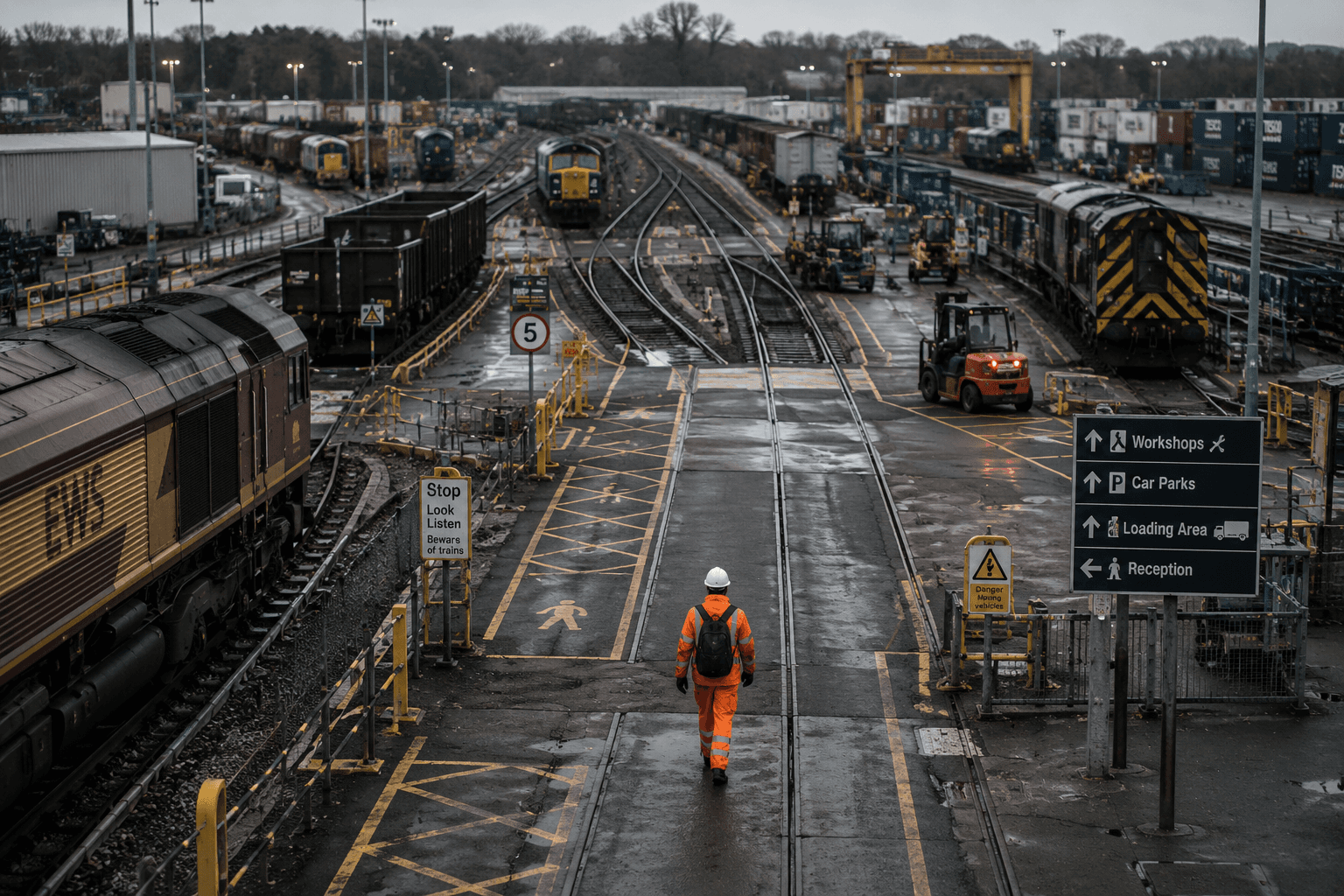
Gaussian splatting is a way of capturing a real physical environment — a depot, a warehouse, a rail terminal, a plant — and turning it into something you can actually move through on a screen. Not a diagram, not a video. Something that behaves spatially: you can walk forward, look left, approach a piece of equipment, get a sense of where things sit relative to each other.
How it actually works
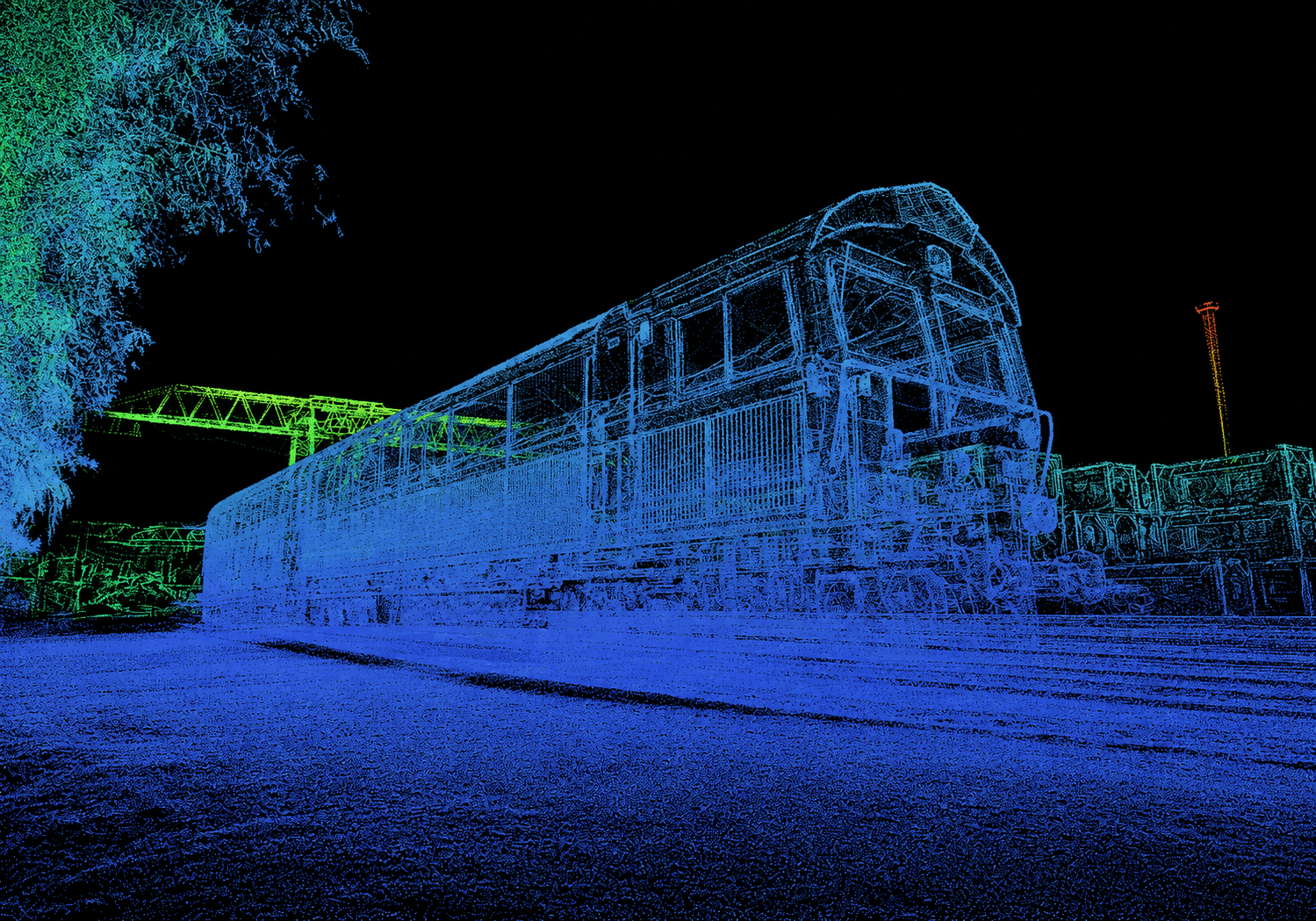
When a space is captured using gaussian splatting, a camera moves through the environment recording it from hundreds of positions. Software then analyses all of that image data and uses it to reconstruct the space as a collection of tiny three-dimensional shapes — ellipsoids, technically, each one carrying information about colour, opacity and position in space.
What makes this different from simply stitching photographs together is that each of those shapes is mathematically defined. The software understands the geometry of the space, not just what it looks like from one angle. That's why you can move through it freely rather than being locked to a fixed viewpoint.
The resulting file is also surprisingly compact. A detailed capture of a large operational environment can be streamed and explored on a standard laptop, a tablet, or a phone — no specialist hardware, no high-end graphics card, no app to download. It runs in a browser, which means it works on whatever device your staff already have.
How it compares to photogrammetry and Matterport
Gaussian splatting isn't the first technology to attempt 3D environment capture, and it's worth understanding where it sits relative to approaches your team may already be familiar with.
Photogrammetry has been around for years. It uses photographs to reconstruct surfaces as a mesh of polygons — essentially a 3D model of a space. It works well for objects and structures where geometric accuracy matters, but operational environments are full of things that cause it problems: reflective surfaces, fine structural detail, areas with inconsistent lighting. The resulting models can be heavy to render and visually imprecise in ways that matter when you're trying to convey what a space actually looks and feels like.
Matterport takes a different approach, using dedicated scanning hardware to capture spaces as a navigable dollhouse model. It's a good product for what it was designed for — property tours, space planning, facilities management. The limitation for operational familiarisation is that it produces a relatively stylised representation of a space. The visual quality is functional rather than photorealistic, and the navigation is constrained to a set of fixed camera positions rather than genuine free movement.
Gaussian splatting produces something closer to what a person actually sees when they're in a space. The detail is there because the capture method is preserving light and appearance rather than just geometry. That distinction matters when the goal is spatial familiarity rather than spatial measurement.
None of this is to say those tools don't have legitimate uses — they do. But for preparing people to work in a real environment, the fidelity gap is meaningful.
The problem it's solving
Most operations teams have been working around the same induction problem for years. Someone needs to understand a site before they start work there — a new team member, a transferred operative, a maintenance engineer being sent somewhere unfamiliar. The options are limited: send them a document, show them a video, or bring them to the site in person.
None of these work particularly well. Documents and videos can describe an environment but they can't convey it. You can tell someone where the hazards are; that's not the same as giving them the spatial awareness that comes from actually moving through the space. And physically transporting people to sites is expensive, slow and difficult to deliver consistently across a large or distributed workforce.
Gaussian splatting addresses that gap directly. The environment becomes the training material. Staff explore the actual site before they arrive, building genuine familiarity with the layout, the hazards, the operational flow. Because it runs in a browser, they can do it from a laptop at home, a tablet in a hotel room, or a phone on the train.
The contractor problem
Contractors are where this becomes particularly relevant for a lot of operations teams.
Permanent staff go through structured onboarding. Contractors often don't — or they go through a compressed version of it that's more about ticking a compliance box than actually preparing someone for the environment. When you're bringing in external workers at short notice, across multiple sites, with varying levels of operational experience, consistent induction becomes very hard to manage.
The risk isn't abstract. A contractor who doesn't understand a site is a liability — for themselves, for the people working around them, and for the organisation responsible for the environment they're operating in.
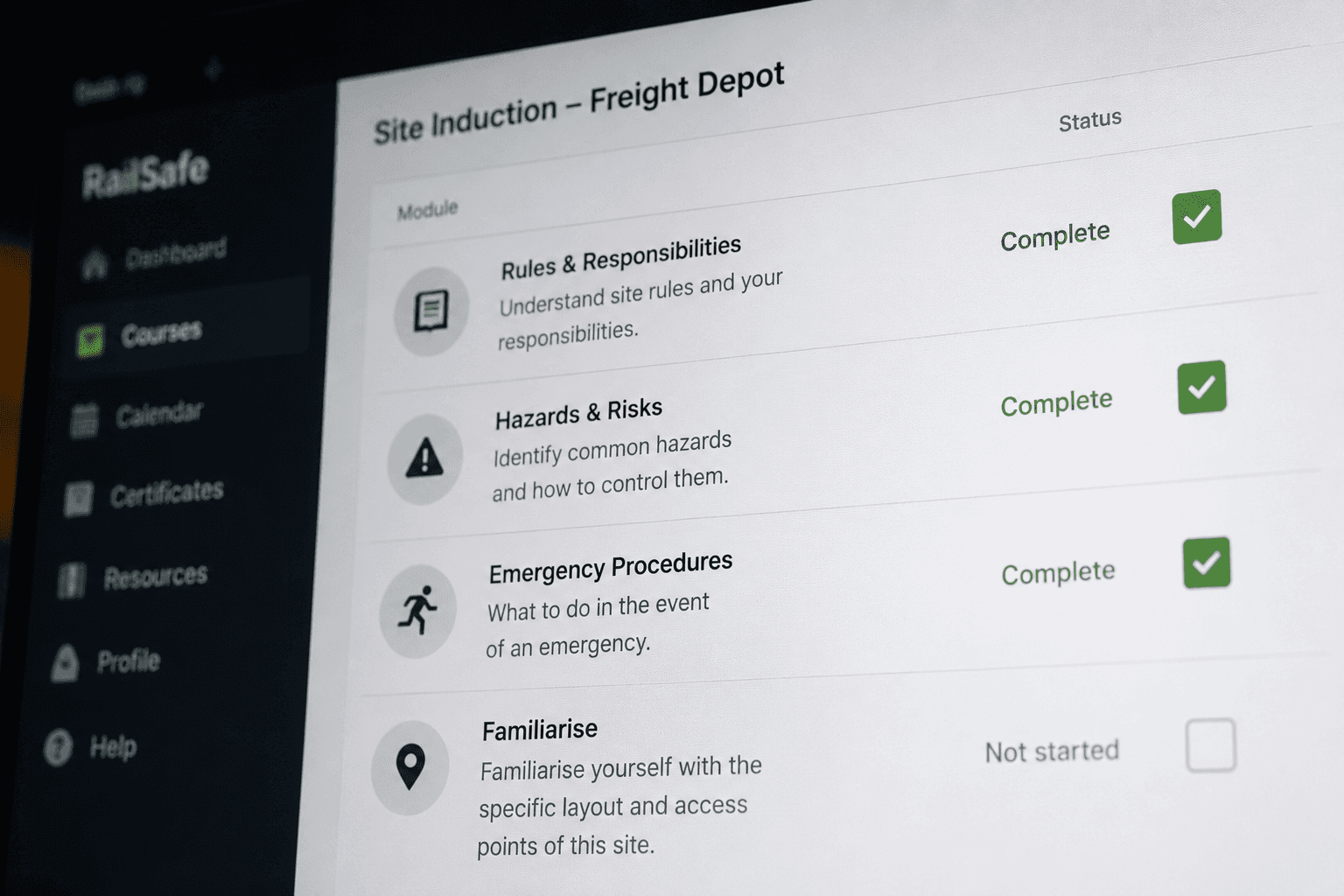
Digital site familiarisation scales in a way that physical induction doesn't. A contractor can be given access to a site environment before they arrive, regardless of where they're based or how quickly they've been mobilised. The knowledge check happens before they walk through the gate. The completion record exists in your system before they've set foot on site.
That's a meaningful shift in how contractor risk gets managed.
What this looks like day to day
For an operations director, the applications are fairly straightforward.
Inductions that previously required a physical visit can happen remotely, at whatever point in the process makes sense. Multi-site operations can deliver the same environment, presented the same way, to every member of staff regardless of location. Knowledge checks and completion data feed into existing learning management systems, so the compliance audit trail builds automatically.
The quality of someone's induction stops depending on who delivered it, where, and on what day.
Why now
The technology has existed in research form for a few years, but it's only recently become fast and high-fidelity enough to be practically useful at enterprise scale. The gap between what it could do in a lab and what you can actually deploy to a large workforce has closed considerably in the last two or three years.
The organisations building spatial familiarisation into their induction and compliance processes now are doing it before it becomes the obvious thing to do. That window won't stay open indefinitely.
Showspace is a browser-based spatial familiarisation platform built for safety-critical industries. We capture real operational environments using gaussian splatting and turn them into interactive experiences your teams can access before they arrive on site.
Prepare people before they arrive.