Why Induction Completion Rates Are the Wrong Metric
Category
Views
Published Date

Chris Chart
Founder
Summary
A 100% completion rate on your site induction looks good on a dashboard. It does not tell you whether anyone actually understood what they were shown. Here is why completion is the wrong thing to measure, and what better metrics look like.
Share this article
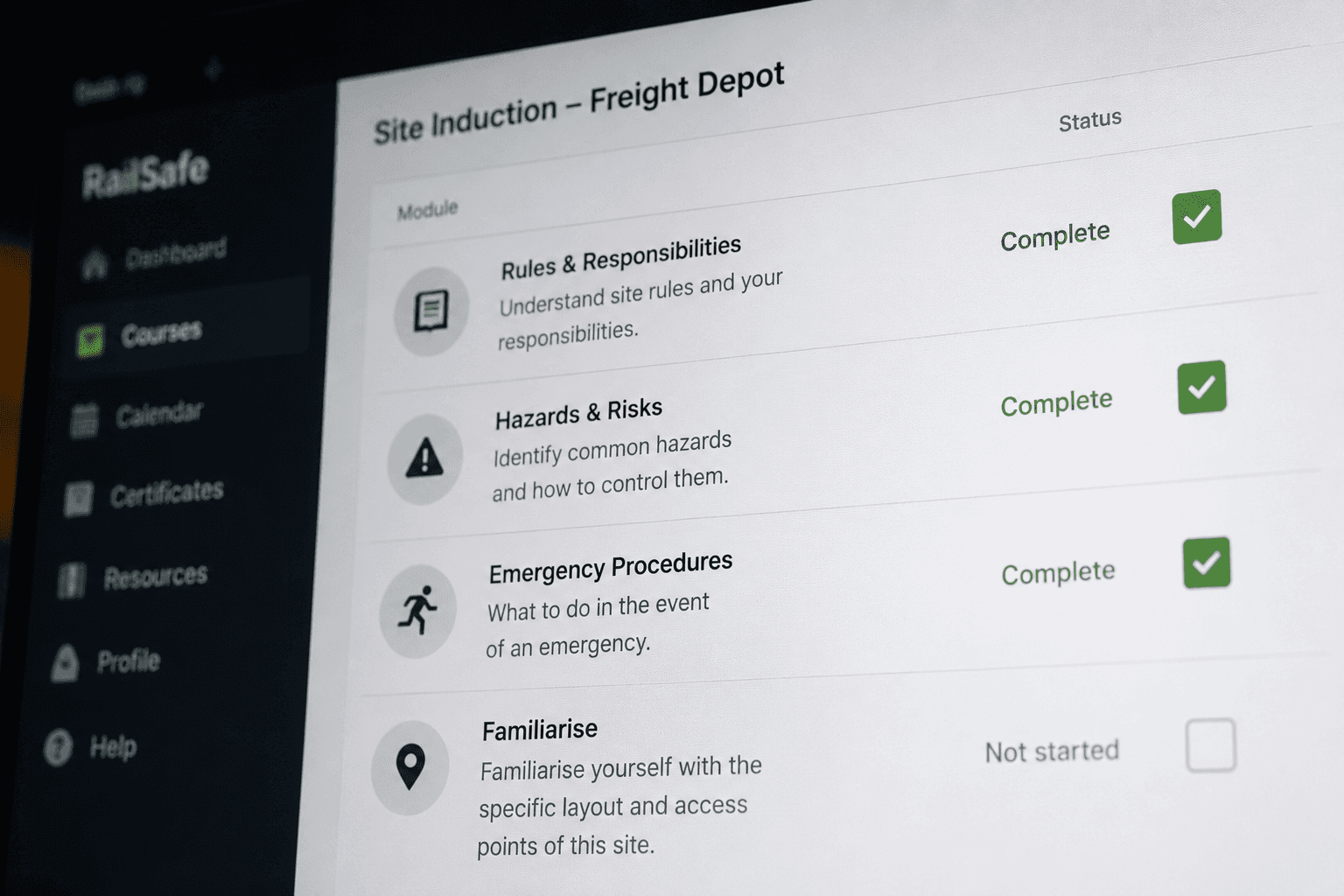
The dashboard shows 100% completion. Every new starter and contractor on site has been through the induction. Every box is ticked, every record is time-stamped, and if an auditor arrived tomorrow the paperwork would be in order.
Three days later, a new starter makes an error that someone familiar with the environment would not have made.
The induction was complete. The worker was not ready. And the completion rate did not tell you the difference.
This is the core problem with measuring induction success by completion. It is easy to track, it satisfies auditors, and it tells you almost nothing about whether your workforce is actually prepared. In safety-critical operations, that gap matters.
Why completion became the default measure
It is worth understanding why completion rate became the standard before dismissing it. It did not happen without reason.
When organisations moved from paper-based induction records to digital platforms, the ability to track completions centrally was a genuine improvement. For the first time, a training manager could see at a glance who had done what, when, and on which version of the content. Compared to signing a paper register and filing it somewhere, that was a meaningful step forward.
Regulators and auditors also reinforced the habit. The question most inspectors ask is whether workers have completed relevant training, not whether they can demonstrate what they retained from it. Organisations optimise for the questions they are likely to be asked, so completion records became the priority.
The result is a system where the measurable output of an induction process — the completion tick — has become a proxy for something much harder to measure: whether the worker who clicked through is genuinely prepared for the environment they are entering.
Those are not the same thing, and in safety-critical operations, treating them as equivalent creates a compliance picture that looks better than the operational reality.
What a completion record actually tells you
A completion record tells you that a specific person accessed a specific piece of content on a specific date and reached the end of it.
It does not tell you how long they spent on each section. It does not tell you whether they were paying attention. It does not tell you whether they understood what they were shown, whether they could apply it under pressure, or whether they will remember any of it in a week's time.
This is not a theoretical concern. The click-through problem is well understood in training and learning circles, and it is particularly acute with digital induction modules. A worker under time pressure, completing an induction on their phone before a morning shift, moving through slides as quickly as the platform allows, is technically completing the induction. The record will show the same outcome as a worker who read every page carefully and took notes.
For low-stakes content, that might be an acceptable trade-off. For safety-critical site induction, it is not. The worker who clicked through without engaging arrives at the site with the same compliance status as the one who absorbed everything. On paper, they are equivalent. On the ground, they are not.
What retention research tells us about passive learning
There is a substantial body of research on how people retain information from different types of learning, and it is not encouraging for anyone who relies on slide-based or video-based induction as their primary method.
The forgetting curve, first described by psychologist Hermann Ebbinghaus in the nineteenth century and replicated many times since, shows that people forget a significant proportion of passively received information within hours, and the majority of it within a few days. Estimates vary depending on the content and the individual, but the consistent finding is that without reinforcement or meaningful context, much of what someone watches or reads does not stay.
Applied to induction, this means that a worker who completed their online module last Thursday and starts on site this Monday has already forgotten a large proportion of what they were shown. The completion record is intact. The knowledge is largely gone.
This is not a criticism of any particular platform. It reflects something fundamental about how passive learning works. Information that is not connected to experience, not reinforced through use, and not anchored in a meaningful context is difficult to retain. A list of rules about a place you have never seen is a particularly thin anchor.
Research into more active, contextual and immersive forms of learning consistently shows better retention. When learning is connected to a realistic environment, when the learner has to navigate or make decisions rather than just observe, and when the content relates to something they can picture, retention improves substantially. This finding holds across industries and training types, and it has significant implications for how site induction is designed.
The difference between passing and being ready
There is a useful distinction between three things that induction processes often treat as one: compliance, knowledge and readiness.
Compliance means the record exists. The worker completed the induction, the timestamp is in the system, and the organisation can demonstrate that the process was followed. This is what completion rates measure.
Knowledge means the worker understood and can recall the content. They know the emergency procedure. They know which areas require a permit to work. They can answer a quiz question correctly. Knowledge checks at the end of a module get closer to measuring this than completion alone, though they still depend on what the worker retained at the moment of testing rather than what they will recall under operational conditions.
Readiness is something different again. A worker is ready when they can apply what they know in the actual environment, when they can move through the site with confidence, make safe decisions without prompting, and handle the unexpected without freezing. Readiness is the thing that actually predicts performance in the first weeks on site.
Completion tells you almost nothing about knowledge. Knowledge checks tell you something about knowledge at a point in time. Neither tells you much about readiness. And readiness is what the induction process is ultimately supposed to produce.
What better metrics might look like
If completion rate is the wrong measure, the question is what to track instead. The honest answer is that there is no single metric that replaces it cleanly, partly because readiness is genuinely harder to measure than completion.
That said, there are measures that get meaningfully closer.
Knowledge retention testing rather than immediate assessment. Testing a worker's recall at intervals after induction — a week later, a month later — gives a more honest picture of what has actually been retained. The gap between end-of-module scores and delayed recall scores is often significant, and it is a more useful indicator of what workers will actually remember when it matters.
Time to full operational confidence. The period between starting on site and working without requiring supervisory support is measurable. If this period consistently runs longer than expected, or varies significantly between workers who arrived via different induction routes, that is meaningful data about induction effectiveness.
Near-miss and incident rates in the first weeks. The early weeks carry disproportionate risk, as the data consistently shows. Tracking incidents and near-misses against time-on-site for new starters gives a direct operational measure of how well the induction process is preparing people. A reduction in early-week incidents following changes to induction design is a result worth having.
Supervisor observation at defined intervals. Structured check-ins where a site supervisor assesses whether a new starter or contractor is demonstrating the expected level of environmental awareness in the first two weeks gives qualitative data that completion records never will.
None of these are as simple to pull from a dashboard as a completion percentage. But they are considerably more informative about whether the induction process is doing its job.
The metric nobody is measuring: environmental comprehension
There is a category of readiness that almost no current measurement approach captures at all, and it is arguably the most operationally significant one in safety-critical environments.
Environmental comprehension is the degree to which a worker understands the specific physical space they are operating in. It is different from knowing the rules, different from passing a knowledge check, and different from having been told about the hazards. It is about whether a worker has a functional mental model of the site: where things are, how the space is arranged, which areas need extra attention, what the traffic flows look like.
This kind of understanding takes time to develop through direct experience. It is also the thing that most directly predicts how someone will behave in the first days on site. A worker with good environmental comprehension moves confidently. They do not need a supervisor to walk them through the space. They can make sensible decisions about where to be and where not to be without prompting.
Measuring environmental comprehension is difficult, partly because we do not yet have good tools for it. But recognising that it exists as a distinct dimension of readiness, and that completion rates say nothing about it whatsoever, is the first step toward designing induction processes that take it seriously.
The question for any organisation reviewing its induction approach is not just whether workers are completing the module. It is whether, at the end of the induction process, they could function safely in the environment they are being prepared for. Completion is a necessary condition for that. It is nowhere near sufficient.
Getting from compliance to readiness
Shifting the focus from completion to readiness does not mean discarding completion records. They serve a genuine compliance function and they are worth keeping.
What it means is treating completion as the starting point rather than the finish line. A worker who has completed the induction has been given the information. The more important question is whether the design of the induction process gives that information the best possible chance of being retained and applied.
That tends to involve making induction more contextual, more interactive, and more directly connected to the actual environment the worker will be operating in. It involves reinforcing key information rather than delivering it once and assuming it has landed. And it involves measuring outcomes, not just outputs.
A 100% completion rate is not a bad thing. It just does not tell you whether your workforce is ready. And in safety-critical operations, the difference between those two things is the difference between a record and a result.
Showspace helps safety-critical organisations prepare workers for the environments they are entering, not just the rules that govern them. If you are thinking about how to move beyond compliance ticking toward genuine operational readiness, we would be glad to have that conversation.