Browser-Based vs VR: What Actually Works for Workforce Familiarisation at Scale?
Category
Tech
Published Date

Chris Chart
Founder
Summary
VR headsets can deliver impressive training experiences in the right setting. For most large-scale workforce familiarisation programmes, though, the practicalities of deployment, device management and adoption create problems that browser-based approaches simply do not have.
Share this article
The interest in VR for workforce training has been building for years. The pitch is intuitive enough: give someone a headset, put them in a realistic simulation of the environment they are about to work in, and they will be better prepared than if you had shown them a video or handed them a document.
In principle, that is right. Immersive, spatially aware learning does produce better retention than passive content. The question for anyone responsible for inducting large numbers of workers is not whether VR can work, but whether it can work at the scale and pace that most operations actually require.
That question is more complicated than the technology evangelism tends to acknowledge.
What VR genuinely does well
It is worth being clear about where VR training has real merit before getting into the limitations, because the limitations are sometimes used to dismiss the underlying insight, which would be a mistake.
VR headset experiences can deliver a level of environmental presence that no flat-screen format matches. When someone is wearing a headset, they are not watching a site walkthrough from a fixed camera angle on a laptop. They are inside a space, able to look around, and their spatial sense of the environment is engaged in a way that two-dimensional content cannot replicate.
For high-stakes, low-frequency training, this matters. Scenarios that would be genuinely dangerous to practise in real life, emergency procedures in confined spaces, high-voltage isolation protocols, behaviour in active trackside environments, can be rehearsed in VR without risk. Research into VR-based training in these contexts consistently shows better retention and more confident recall than equivalent non-immersive methods.
In the right context, with the right content, VR is a genuinely effective workforce familiarisation technology. The constraints come when you try to move from controlled pilot to operational deployment.
The deployment problem
A training exercise that requires a headset is only as good as your ability to get headsets in front of workers. That sounds obvious, but it is where most large-scale VR training programmes run into difficulty.
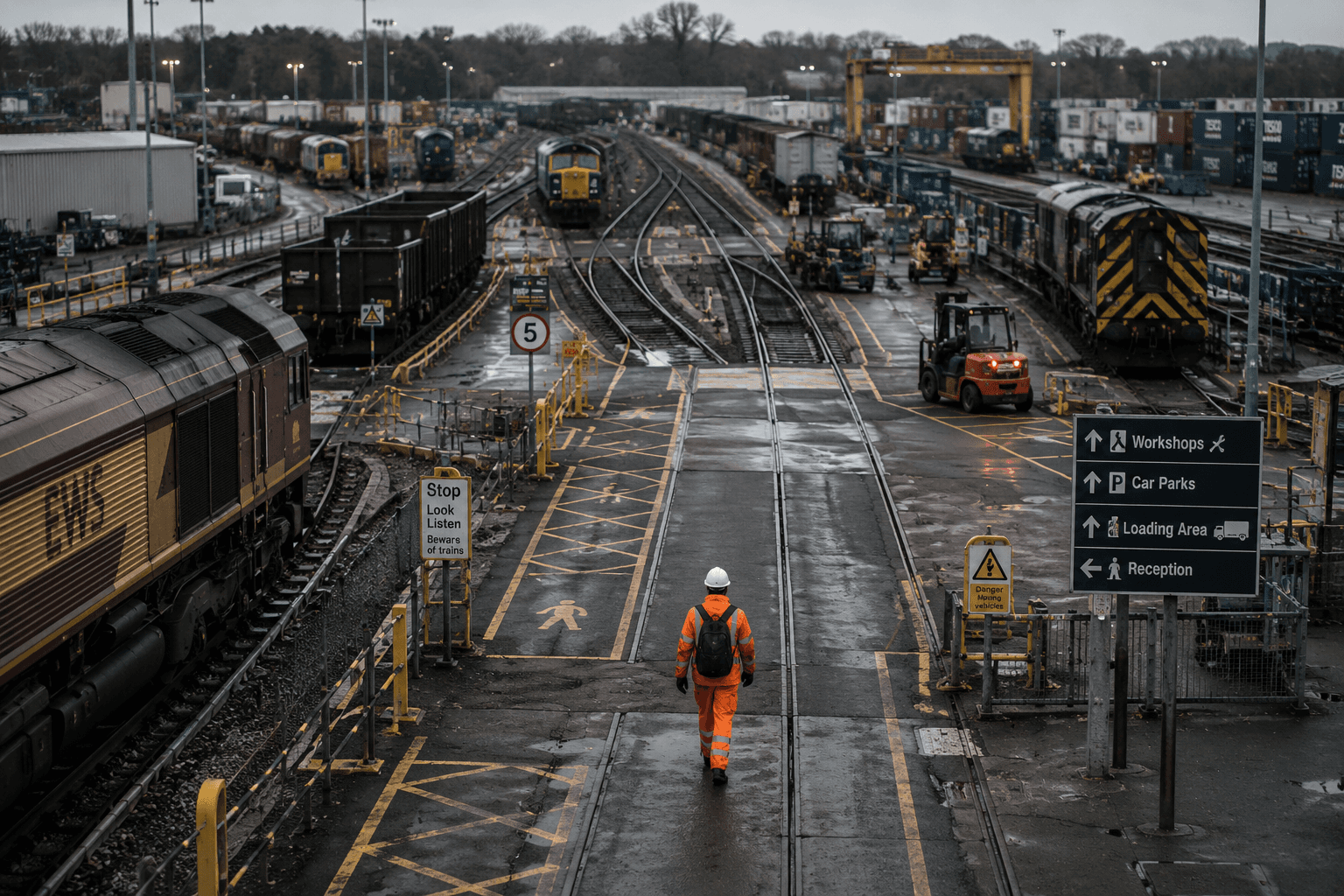
Consider a rail freight operator onboarding a combination of permanent employees, agency workers and contractors across a network of depots. The headsets are at one location. The workers are arriving at several others. Some need site familiarisation before they start on Monday. Some are contractors who will be on site for two weeks before moving on. Some are completing their induction at 6am before a morning shift.
The logistics of getting a headset into the right person's hands at the right time, at the right location, before they set foot on the site are not trivial. In practice, many organisations resolve this by having headsets available at a central location, which means the induction has to happen there rather than wherever is most convenient for the worker. For smaller workforces with predictable onboarding patterns, that is manageable. For high-volume, geographically distributed operations, it is a real constraint.
Device management at scale
Beyond the logistics of physical distribution, there is the ongoing overhead of managing a fleet of headsets in a working industrial environment.
Headsets need charging, storage and maintenance. Firmware updates need to be applied and tested against training content, which can break compatibility without warning. Hygiene protocols for shared devices need to be followed and enforced. Headsets get dropped, scratched and eventually replaced. Each device is a physical asset that needs to be tracked and managed.
For an L&D team running a modest programme with a handful of headsets used weekly in a controlled room, that overhead is tolerable. For an H&S Manager trying to ensure that every new starter and contractor arriving at six depots has been properly prepared for each specific environment, it becomes a significant operational burden.
This is not a reason to rule out VR. It is a reason to be clear-eyed about what the operational overhead of running VR at scale actually looks like before committing to it.
The adoption question
There is another constraint that receives less attention than the logistics, partly because it is harder to quantify: the proportion of your workforce who will actually engage with a headset-based induction willingly.
For some workers, particularly those who are younger, more comfortable with gaming technology, or simply curious, putting on a headset is not a barrier at all. For others, including a meaningful proportion of experienced operational workers in industries like rail freight, logistics and manufacturing, it feels unfamiliar, slightly disorienting, or simply unnecessary.
This matters more in safety-critical environments than it might in other contexts. If part of your workforce approaches the induction with reluctance or discomfort, the quality of the preparation they receive is reduced regardless of how good the content is. An anxious or sceptical worker moving through a VR environment quickly to get it over with has not benefited in the way the technology intended.
Headset-free training is not a compromise on immersiveness. For many workers, it is the condition under which they will actually engage properly.
What browser-based spatial platforms offer
Browser-based immersive training approaches the same problem from a different direction. The goal is the same: give workers a meaningful spatial understanding of the environment before they arrive. The delivery mechanism is different.
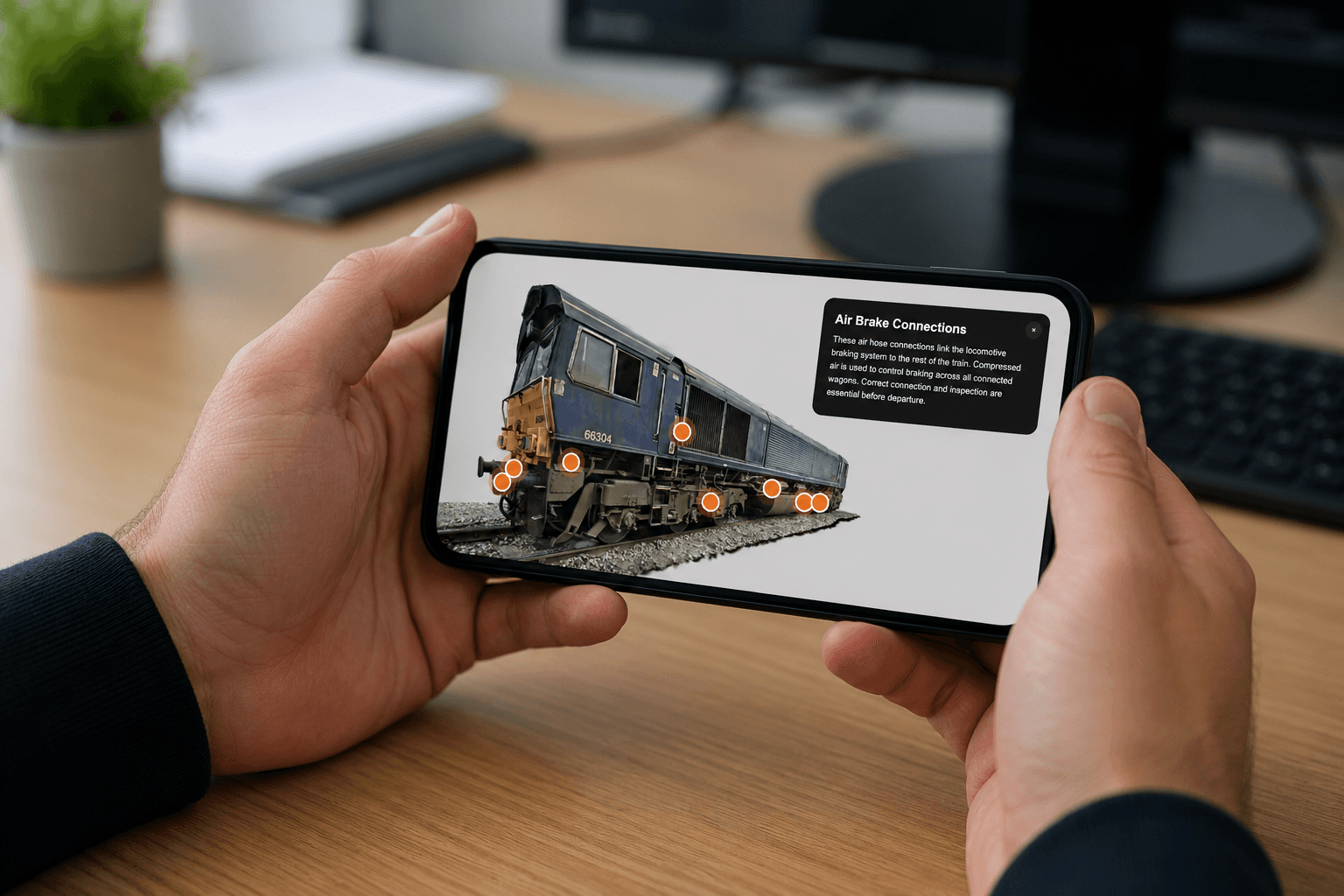
Rather than requiring a headset and a dedicated device, a browser-based approach runs on whatever device the worker already has. A phone, a tablet, a laptop, a desktop in a site office. The experience is accessed via a link, it does not require installation, and it can be completed from any location with a connection.
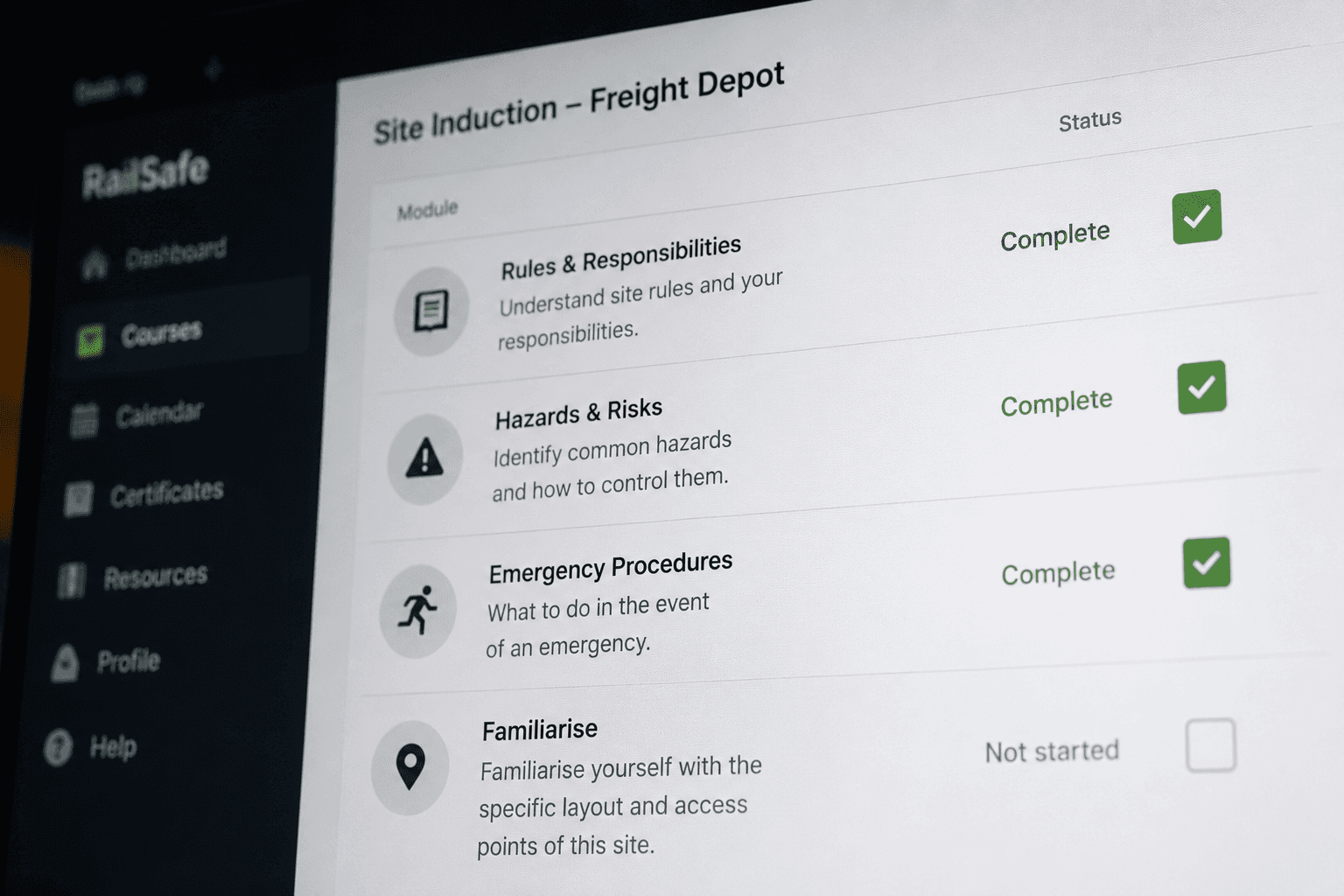
For a contractor who needs to familiarise themselves with a new depot before starting on Thursday, that means accessing the content on Wednesday evening from wherever they happen to be. For an H&S Manager inducting agency workers at short notice, it means sending a link rather than scheduling a headset session.
The spatial quality of the experience depends on how the content is built. Modern browser-based spatial platforms, particularly those built on photogrammetric capture or gaussian splatting technology, can produce site representations that are visually detailed and navigationally meaningful. They are not identical to a headset experience in terms of presence, but they offer genuine spatial orientation rather than the flat-screen walkthroughs that most workers have been receiving up to now.
Content management and keeping things current
One of the less-discussed practical advantages of browser-based immersive training is how much easier it is to keep content current.
A VR induction module is typically a produced asset. It takes time and cost to create, and updating it when the site changes, when new equipment is installed, when access arrangements are revised, requires a production cycle. Operators who have committed to VR inductions for a specific environment sometimes find themselves in the uncomfortable position of inducting workers on a virtual version of the site that no longer reflects the real one.
Browser-based spatial content built from site capture can be updated more readily when conditions change. The overhead is lower, and the lag between a physical change on site and an update to the induction content is shorter.
For operations where site layouts, plant configurations and access arrangements change regularly, that matters. An induction that prepares workers for how a site looked six months ago is less useful than it appears on paper.
Accessibility and reach across a distributed workforce
The reach question is worth dwelling on because it is often where the comparison between headset and browser-based approaches has the clearest practical outcome.
VR induction reaches the workers who are in the right place at the right time with access to a working headset. Browser-based induction reaches anyone with a link and a device, which in most modern workforces is effectively everyone.
In sectors like rail freight and industrial logistics, where a significant proportion of the workforce is mobile, contracted or brought in at short notice, the ability to issue induction content as simply as sharing a link has a direct effect on compliance rates and operational readiness. Workers can complete familiarisation before they arrive. Supervisors can verify completion before anyone enters the site. The compliance record is generated automatically.
None of that requires a headset or a dedicated space.
Browser-first does not mean headset-excluded
One point worth clarifying before drawing any conclusions: browser-based and VR viewing are not mutually exclusive.
Spatial content built from site capture can be experienced in a browser on any device, but it can also be viewed in a VR headset. The underlying content is the same. The delivery mode is simply whatever the worker has available.
This changes the comparison slightly. Organisations that already have headsets for other training purposes, or that want to offer headset viewing in specific controlled settings, are not locked into a single mode. Browser-first means accessible by default — any worker, any device, no logistics overhead. VR viewing becomes an option on top of that, not a separate track requiring separate content.
Workers who complete their familiarisation on a phone before arriving get the same spatial environment as someone who walks through it in a headset. The question is not which experience is available. It is which experience is practical for each worker in each situation.
Which approach for which situation?
The most honest answer to the browser-based vs VR question is that they are best understood as different tools rather than direct competitors.
VR headset training earns its overhead when the content is genuinely hazardous to rehearse in real life, when the target audience is engaged and comfortable with the technology, and when the training frequency is low enough that the logistics of device management are manageable. Specialist safety training for small teams working in high-risk scenarios is a reasonable fit.
Browser-based immersive training is better suited to high-volume, geographically distributed workforce familiarisation, where the priority is giving large numbers of workers a genuine spatial understanding of site environments before they arrive, across a range of devices and without logistical complexity. For operators inducting contractors, agency workers and new permanent staff across multiple sites, this is the practical choice.
The two are not mutually exclusive, and some organisations use both. The key is being clear about what problem each is actually solving, rather than assuming that the more technically impressive option will automatically produce better operational outcomes.
Getting to readiness at scale
The goal of any site familiarisation process, whether it involves a headset or not, is the same: workers who arrive on site with a meaningful spatial understanding of the environment they are entering, not just a compliance record that says they watched something.
The technology that achieves that most reliably for most operations is not necessarily the most sophisticated one. It is the one that can be deployed consistently, completed by the actual workforce in the actual conditions they work in, and kept current as real-world sites change over time.
For organisations inducting workers at scale across multiple sites, browser-based approaches meet that bar in ways that headset-only programmes often struggle to.
Showspace is a browser-based spatial familiarisation platform built for safety-critical industries. If you are evaluating options for site induction across a distributed workforce, we would be glad to show you what it looks like in practice.
[Get in touch with Showspace]